
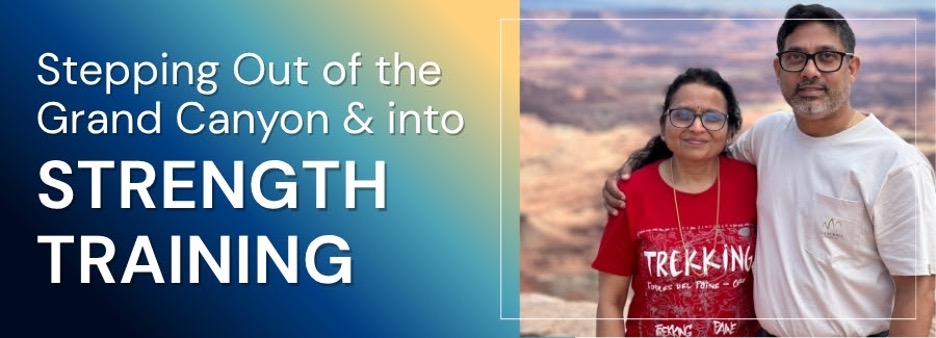
 Climbing out of the Grand Canyon, Pranjal Karmakar had an a-ha moment.
“I could see other folks who looked older than I was, and they were doing much better,” he recalls. “I knew then it was time to take action when I got home.”
He and his wife, Deepa, love traveling to hike in national parks. But the hiking he was already doing wasn’t enough. “At some point, you start losing muscle and strength,” he says. “It made sense to do regular strength exercises.”
Which brings up a question we hear all the time:
Isn’t walking “good enough?”
The short answer: Nope. Sorry, but it’s not.
Walking is a great first step — pun intended. It’s easy, you can do it anywhere, and you need nothing but good shoes. You can burn 300 calories an hour, more if you pick up the pace or add some hills. A consistent routine can even lead to meaningful weight loss for someone just starting out.
To keep improving, though, you’ll need to increase intensity or duration over time — adding short jogging intervals, for instance, or light hand weights. Walk at a brisk enough pace that a long conversation is a challenge. That’s the level needed to move the needle on blood pressure and cholesterol.
But even a great walking routine has limits. From our 30s onward, we naturally lose 3 to 5 percent of our muscle mass per decade, and that rate accelerates after 60. Walking won’t build or preserve the muscles needed for daily tasks like carrying groceries, standing from a chair, or getting up off the floor. It also doesn’t challenge your balance systems the way targeted stability work does — and falls are a leading cause of injury in older adults.
A well-rounded routine after 50 should include:
- Walking and moderate cardio — keep doing it; aim for 150 minutes a week
- Strength training — at least twice a week to counter muscle loss and protect your bones
- Balance and mobility work — to stay agile, prevent falls, and move with confidence
Now He’s Really Out There
Pranjal started weight training in 2022. Even pushups were a challenge back then. Sometimes just finishing a workout had to be enough for the day. Working in a small group with a personal trainer, he found the balance and instruction he needed.
Now he and his wife, who also became a gym member, have a full calendar. Last year, they went to South America to hike in Patagonia, managing 14-hour days over steep, high-altitude terrain with strength and confidence.
Next on the list: the Dolomites and Everest Base Camp.
“We can do this now,” Pranjal says. “We are there.”
He turns 50 this year. He’s never been stronger.
So, call us and let us show you the next steps on your fitness journey — to strength, stamina, agility, and the life you want.
Holly Kouvo is a personal trainer, functional aging specialist, senior fitness specialist, brain health trainer, writer, and speaker.